Contents

  • EDU 119

    Section outline

    • Highlighted

      Trauma-Informed Practice

      • In this module, we will move to a new important topic in the early childhood field, child trauma is very real and from everything we see in the media as well as social media, we need to know how to...

        • Given the importance of understanding, identifying, and knowing how to respond to child trauma, the faculty of the NC Community College system along with support from the Center for Child and ...
        • Toxic Stress

          Toxic stress response can occur when a child experiences strong, frequent, and/or prolonged adversity -- such as physical or emotional abuse, chronic neglect, caregiver substance abuse ...

      • What is the difference between a Traumatic Event and an Adverse Childhood Experience (ACE)?

        • The term Adverse Childhood Experience came out of a study in 1998 that impacted the health care and mental...
        • According to the NCTSN, children who suffer from child traumatic stress has been exposed to one or more traumatic events over the course of their lives and develop reactions that persist and affect...
      • Trauma

        Defining a Traumatic Event:

        What is a traumatic event?

        • A traumatic event is a frightening, dangerous, or violent event that poses a threat to a child’s life or bodily integrity. Witnessing a ...
      • How do children respond to trauma?

        No matter their age, traumatized children may: 

        • seek or demand more attention, 
        • show aggression, 
        • seem withdrawn, 
        • startle easily, 
        • have sleep problems, 
        • have separation...
      • What Experiences Might Be Traumatic?  

        Image of an adult hand reaching towards a child's face looking up.

        • Physical, sexual, or psychological abuse and neglect (including trafficking)
        • Natural and technological disasters or terrorism
        • Family or community violence
        • Sudden ...
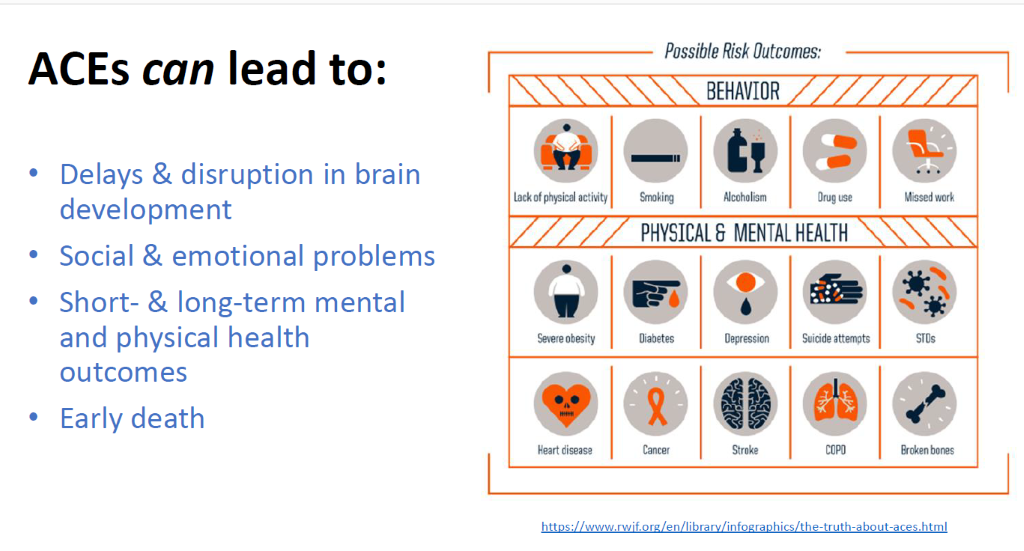
      • Image of possible risk outcomes that may affect individuals with adverse childhood experiences.

        The study identified the following as ACES: 

        • Abuse: Physical abuse, sexual abuse, and emotional abuse 

        • Neglect: Physical and emotional neglect 

        • Household Dysfunction: Caregiver who has a mental ...

      • There are several main categories or types of trauma that are important to know about: 

        • Acute trauma-A single traumatic event that lasts for a short time (for example- car accident, dog bite, ...

      • At no age are children immune to the effects of traumatic experiences. Even infants and toddlers can experience traumatic stress. The way that traumatic stress manifests will vary from child to ...

      • According to the National Child Traumatic Stress Network, a Trauma-Informed Child and Family Service Syste Links to an external site. is on in which agencies, programs, and service providers:

        • Rout...
      • On Children

        Factors that Influence the Effects of Traumatic Event:  The effects of traumatic events can be influenced by a number of factors. Depending on the specific nature of the event, these ...

      • What is resilience?

        • The ability of child to recover and show early and effective adaptation after a potentially traumatic event
        • The ability for a child to respond to the event with minimal distress ...
      • (Please note: some of the content regarding DSS Reporting may be repeated from the Child Abuse and Neglect content from earlier in this course. However, you should still review the content on this ...

Course Dashboard

    Accessibility

    Background Colour Background Colour

    Font Face Font Face

    Font Kerning Font Kerning

    Font Size Font Size

    1

    Image Visibility Image Visibility

    Letter Spacing Letter Spacing

    0

    Line Height Line Height

    1.2

    Link Highlight Link Highlight

    Text Colour Text Colour